Being a writer can be a tough job because there are so many things that you have to keep track of during the writing process. And any mistake you can make in the writing process can come back to haunt you in the long run. But of all the possible mistakes you can make, there is nothing more embarrassing than misspelling and misusing common words.
This is because proper spelling and word usage are one of the most basic aspects of being a writer. So if you are thinking of writing a book or just writing an email to a friend, make sure to always check on your spelling.
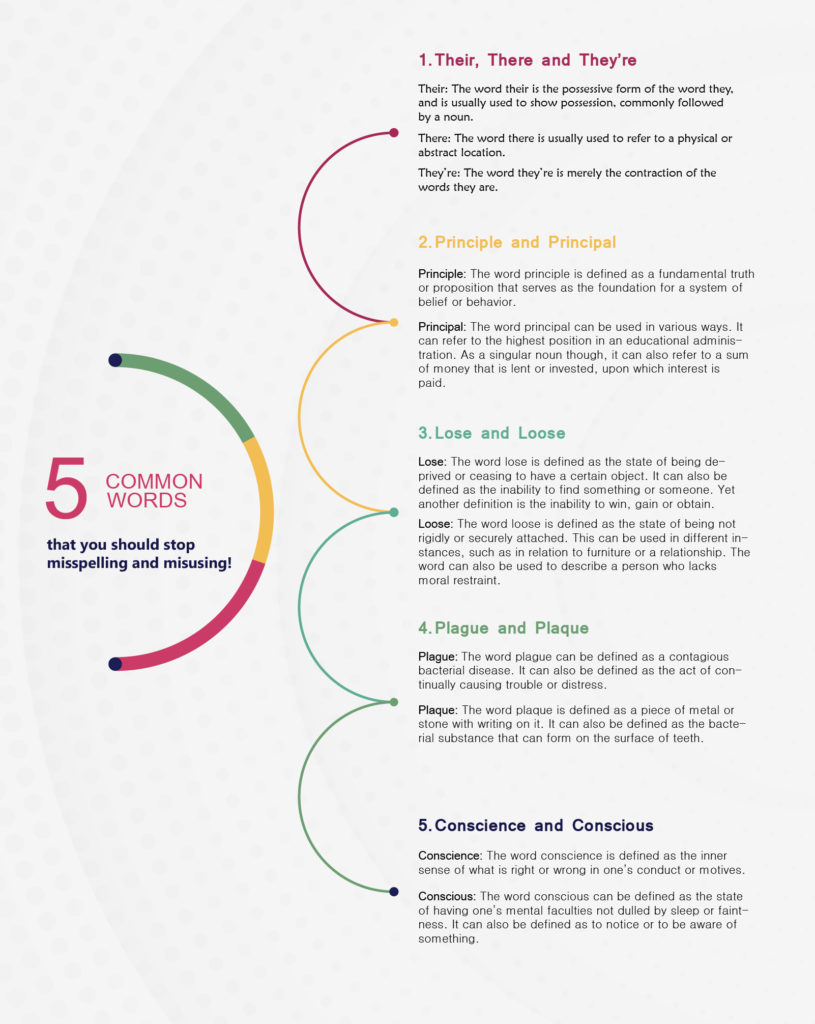
Just to help you out, here are 5 common words that you should stop misspelling and misusing:
- Their, There and They’re
When it comes to commonly misspelled words, these three words take the cake. This is because some writers get confused on which one is which. And they also get confused on how to use them properly. So to clear up the confusion here is a short description of the words and their proper usage.
Their: The word their is the possessive form of the word they, and is usually used to show possession, commonly followed by a noun.
Example:
- Their party was a big success!
- Did you go to their wedding?
- Their car is incredible
There: The word there is usually used to refer to a physical or abstract location.
Examples:
- There it is!
- I left your books over there.
- I want to go there someday.
They’re: The word they’re is merely the contraction of the words they are.
Examples:
- They’re coming over tonight!
- They’re running over to the next building.
- They’re sparring with each other.
- Principle and Principal
Principal and Principle are commonly misused words because they technically look and sound the same. But despite their similar appearance and sound they are very different from one another. Here are their definitions and proper usage.
Principle: The word principle is defined as a fundamental truth or proposition that serves as the foundation for a system of belief or behavior.
Examples:
- The art of Karate is based on the core principles of self-defense
- I will not give up my principles for something as low as money!
- I am determined to stick by my principles
Principal: The word principal can be used in various ways. It can refer to the highest position in an educational administration. As a singular noun though, it can also refer to a sum of money that is lent or invested, upon which interest is paid.
Examples:
- I think the principal is very strict.
- The principal is difficult to pay.
- The principal is a kind and nurturing man.
- Lose and Loose
Lose: The word lose is defined as the state of being deprived or ceasing to have a certain object. It can also be defined as the inability to find something or someone. Yet another definition is the inability to win, gain or obtain.
Examples:
- Did you lose your hat yesterday?
- You are going to lose the match if you don’t try harder.
- Did I lose the fight?
Loose: The word loose is defined as the state of being not rigidly or securely attached. This can be used in different instances, such as in relation to furniture or a relationship. The word can also be used to describe a person who lacks moral restraint.
Examples:
- The nails on the shelf is a bit loose.
- She has always been a bit of a loose woman.
- Your dress is loose my dear.
- Plague and Plaque
Plague: The word plague can be defined as a contagious bacterial disease. It can also be defined as the act of continually causing trouble or distress.
Examples:
- The village has been wracked by plague.
- Don’t plague this house with your presence.
- You are a plague on your own people.
Plaque: The word plaque is defined as a piece of metal or stone with writing on it. It can also be defined as the bacterial substance that can form on the surface of teeth.
- There is a lot of plaque on your teeth.
- Did you see the general’s huge plaque?
- I want the plaque to be made of gold and ivory.
- Conscience and Conscious
Conscience: The word conscience is defined as the inner sense of what is right or wrong in one’s conduct or motives.
Examples:
- I hope what you did will weigh heavily on your conscience.
- My conscience kept me up all night.
- The man has no conscience.
Conscious: The word conscious can be defined as the state of having one’s mental faculties not dulled by sleep or faintness. It can also be defined as to notice or to be aware of something.
Examples:
- I hope he will be able to stay conscious until we get to the hospital.
- It’s incredible he is still conscious after being punched like that.
- Will he be able to stay conscious despite the lack of oxygen in the tank?
The BookVenture Company hopes this article was useful.
To enjoy more articles and blogs, please follow us on BookVenture Facebook and BookVenture Twitter. BookVenture is always ready to help you on your self-publishing journey.


